sonora2sonoma

  • A collection of short essays on my recollections of growing up in the Sierra foothills in the 1950s.

    By Tim Konrad

    Everyone has their own favorite stories to tell, and my father was no exception. He loved to recount events from his past, often after he’d had a few shots of bourbon to loosen his tongue. Among the tales from his younger days that he was fond of narrating was one about the deer that jumped over the moon.

    Back in the 1920s, when my family was living at the Von Tromp Mine, northeast of Columbia, they owned a roadster made by the Moon Motor Car Company. One warm summer’s evening, my mother and father and my Aunt Dorothy and Great Aunt Vida struck out for town leaving the roadster’s soft top folded back so they could enjoy the moonlight filtering through the trees.

    As they were descending the grade on Italian Bar Road just above the old brewery, a deer leaped without warning from the bank overhanging the roadway, passing within inches of everybody on its way down the hill.

    Another story my Dad recalled from the 1920s was about a visit he and his brother, Jack, made to a bar in Angel’s Camp.

    The place had been packed with celebrants, in town to participate in the annual festivities inspired by Mark Twain’s famous story “The Celebrated Jumping Frog of Calaveras.”

    Many of those present were taking full advantage, my uncle included, of the liberal dispensation of libations flowing  uninterruptedly from the bar. Before long, my uncle became engaged in a scrap with an Angel’s Camp boy.

    My storied uncle was never one to shy away from a good fight. He had once broke the nose of a young man he’d been scrapping with in Sonora. Unfortunately, for Jack, the young man’s father had turned out to be a supervisor with the Civilian Conservation Corps. This man was a person of considerable influence; because of his standing in the community, the matter achieved outsized attention. As a result, my uncle was sentenced to a term of several months in the county jail.

    In his fight with the fellow from Angel’s Camp, Jack was unaware his opponent had a twin brother who was also involved in the melee. No sooner would Jack knock the man down than his brother would rise in his stead, eager to continue the fracas.  My uncle, unsuspecting and undaunted, continued to hold his own.

    Meanwhile, the bystanders were becoming more and more agitated, incensed that this ‘stranger’ was getting the better of his two opponents. My father took notice of the group’s growing unease. The foothill towns displayed a stronger sense of community back then, and inter-community rivalry was common. Observing that the lion’s share of those assembled to witness the event were, naturally, rooting for the twins and were not likely to take their defeat lying down, my Dad saw no reason to waste time pondering the plausible implications of his observation. Grabbing Jack, he hustled him away to their car, whereupon they made a hasty retreat back to Tuolumne County.

    As noted above, rivalry between communities was not uncommon in days past, but its rough edges were often smoothed over and made to appear more civilized through the medium of athletic competitions like baseball and football.  Prior to the rise of professional sports franchises, minor league baseball and football were an essential part of life in the foothills and beyond. These days, local rivalries are mostly seen in high school and college sports.  

    The rules were a little different in those days too. Contrary to the current emphasis in the sport of football concerning the long-term effects of concussions on players, my Uncle Jack told of a football game he played in as a young man in which one of his team-mates—a big Indian fellow—played a whole quarter with a broken shoulder. Such behavior, while viewed as evidence of manliness in those days, would be neither advisable nor possible in this age of frivolous lawsuits.

    ***

    Sometimes community rivalry can take on a deeper tone. A life foolishly lost at an E Clampus Vitus gathering in the 1970s led to a decade of hard feelings between rival communities and a several-years suspension of Clamper festivities that wasn’t lifted until it was agreed that no more guns or knives would be allowed at gatherings.

    The event, or “Doins,” as they are referred to in Clamperdom, took place at the former site of a placer mining operation at the foot of Big Hill east of Columbia. The victim was the cook for the gathering and was from a prominent Angels Camp family with roots going back to the Gold Rush. The fellow with the gun was a member of an old-time Columbia family with similar tenure on the south side of the river. The latter man hadn’t meant any harm and believed he was shooting blanks when he shot the cook in the stomach at near point-blank range as he was going through the food line.

    My father, his friend “Bing,” and I had just been through the line and were sitting down eating around 50 feet away when we heard the gunshot. I remember seeing a crowd gather around the food line as confusion spread and medics were called. The hapless fellow was taken to hospital but his injuries were too severe to stop the blood loss and, late that night, he succumbed. The Columbia man was convicted of manslaughter.

    Justice is a bittersweet solution that does nothing to ease the pain of the loss of a loved one.

    The owner of the property where the ‘Doins’ took place, a man named Bartell Kress, himself had a colorful history. As the story was told to me, this fellow purchased a brand- new Cadillac from the local General Motors dealer with the stated intention of paying it off in installments. Some months later, when the sum of his missed payments triggered alarms concerning his true intentions vis a vis his loan, he began receiving demands for payment from the lender threatening to repossess the vehicle if his arrears weren’t addressed.

    Not a person to be outdone, so the story went, and inclined by nature not to yield to pressure of this sort, Mr. Kress devised a novel way to conceal the Caddie’s whereabouts while guaranteeing the failure of any future attempts at repossession. With the aid of his D-8 Caterpillar tractor, Kress dug a hole deep enough to conceal the vehicle, at an undisclosed location, and then dropped the Cadillac into it and covered it up.

    ***

    The foothills were full of characters back then—in some cases tough individuals who had their own ideas about how to deal with life’s little problems. One such person was the owner of a famed and fabled downtown Sonora saloon. When I was a boy I recall going inside the place and seeing large photographs on the walls—mural sized but crude in quality—that depicted large pits dug in the ground that were filled with dead cattle—the result of an extermination campaign designed to eradicate an outbreak of hoof and mouth disease back in the 1920s.

    The owner of this establishment had the misfortune, one evening, to be shot in the face by an unnamed assailant. Owing more to luck than anything else, the wound did not prove fatal. The police had their hands tied because the victim refused to identify the shooter, so the case remained, and still is to this day, unsolved. The owner was quoted at the time as having said he would deal with it in his own way. The man is now long since passed, but I had the good fortune to chat with his daughter a few years ago. She would not speak to the identity of the assailant except to say her father “dealt with it.”

    Another shooting incident at a different downtown Sonora bar in the same general time period involved a disagreement over a card game gone wrong. The guilty party, angered after he was caught cheating, stormed out of the place, only to return a short while later armed with a pistol; he then walked up behind the man who’d caught him cheating and, after the fashion of the man who shot Wild Bill Hickock, also during a card game, shot him in the back of his head at point-blank range.

    Imagine this fellow’s surprise when the victim rose up out of his chair and proceeded to take matters into his own hands. It turned out the pistol was only a 22 caliber–not an efficient choice for a murder weapon–and his intended victim was an extremely large Mi-Wok man with an unusually thick skull. The projectile deflected when it encountered the man’s skull, circling to the left under the skin and exiting from the back of his head. A witness to the incident told me, years later, that the offender received a good thrashing from his intended victim for his transgression.

    There were a couple of MiWok families from the town of Tuolumne who produced young men of exceptional size, averaging 6’ 5” and weighing between 280 and 320 pounds. I once watched one of these behemoths climb over three booths of diners at a local restaurant in response to a challenge from an antagonist. On another occasion, I witnessed a group of these individuals cruising main street in Sonora on a Sunday afternoon with the tapper from a keg of beer visibly protruding above the back seat of their vehicle.

    The local police chose discretion with these folks whenever possible, for obvious reasons. They pulled over the car in front of a liquor store on the south end of town, one patrol car in front and another behind the partiers, to keep them contained within their vehicle while a solution was negotiated—take the party somewhere else or face arrest.

    To be continued:

  • A collection of short essays on my recollections of growing up in the Sierra foothills in the 1950s.

    By
    Tim Konrad

    Few things in life have the power to evoke long-forgotten memories than the plaintive sound of a lonely train whistle. Thanks to the recent return of rail travel to Sonoma County, this sound is now heard several times each day in my community and, each time I hear it I am brought back to the comforting wail emanating from the Sierra Railroad’s locomotive every afternoon as it wound its way up to the train station at the south end of Sonora. I recall accompanying my father as he went to the train station to receive the paint shipments that enabled him to provide for our family while I was growing up.

    As a small boy, I remember the guilt-tinged fascination with which I would steal glimpses of the calendar girl pinups lining the walls inside the freight-receiving section of the train station. Pictures of scantily-clad women, a novelty for an 8-year-old boy unaccustomed to such things, became something to look forward to when going to pick up paint with my father.

    The rail line played a big part in meeting the area’s freight needs at that time.  The freight depot, located where the post office sits today, was a handsome building with a deck on the receiving side whose height was just right for off-loading freight onto awaiting trucks.

    The train had been reduced to a freight- hauling line by the time I came along. In an earlier age, before a bigger and more ambitious train station had fallen victim to fire, the rail line had ferried passengers bound for the foothills and beyond. Today, most of the passengers riding the rails in these parts are  tourists, visitors to the area who arrive in Jamestown by automobile to board trains for short excursions on summer weekends and special occasions.

    In reflecting on the ability of sounds, such as that of a train whistle, to summon long forgotten memories, another sound familiar from childhood comes to mind—the once familiar sound of a rooster crowing to herald the arrival of the new day. When I was little, John Antonini, an old man who lived uphill from us, kept chickens in a pen lorded over by a rooster. Each morning, the rooster would proclaim the coming of the dawn with unfailing regularity. Anyone who doubts that roosters are early risers is someone who has never lived close enough to one to be relieved of such nonsensical thinking!

    Many were the times I cursed that bird as a teenager after having stayed up partying half the previous night! It was sheer folly to cling to the belief I could sleep in late and recapture lost hours of rest! My mother used to remind me of this often, saying “you can’t burn the candle at both ends.” But alas, motherly advice has the staying power of snowflakes vaporizing before the morning sun, and I’ve lost count of the number of times I sought sleep only to find folly instead.

    Indifferent to my dilemma, the infernal fowl pursued his instinctive impulse with insouciance, functioning like a biological alarm clock signaling the spreading light with the dependability of a Swiss watch and the forceful assertiveness of a foghorn. 

    When I was younger, there was no going back to sleep once I was awakened, no matter  how late I’d been up the night before. Had I been bolder back then, I might have consoled myself when the bird awakened me with thoughts of its demise. Had I been more confident in myself, I might have even considered various courses of action to hasten such an outcome. Fortunately, I’ve recently learned a new phrase from listening to senators evade questions during tv interviews that works well when confronted with dodgy questions of this nature: “I don’t do hypotheticals!”

    I eventually learned to accept the sound of the rooster’s crowing and even, in time, to appreciate it. One of the blessings of the passage of time is its ability to promote acceptance of that which is beyond one’s ability to change—a life lesson whose applicability has extended far beyond the confines of the conditions which, in this case, as in many others, nourished it into being!  I hear no such morning delights these days in Petaluma. Alas, the freedom to raise farm animals is not commonly regarded as compatible with the dictates of urban living.

    ***

    There was interest on the part of Caltrans in the 1970’s to construct a bypass of Highway 108 around Sonora. The downtown merchants at the time mounted a concerted effort to prevent this from occurring for fear their businesses would suffer. There was another effort back then to re-route Highway 49 around Sonora in the hills to the east of town, but this effort was struck down largely thanks to the efforts of a politically-savvy retired high school teacher whose house, perched on a hill high above town, lay in the middle of the proposed right of way.

    As time passed, traffic worsened considerably in the town, intensified by the two state highways running through the heart of it. The more congested it became, the more clamor there was to revive the 108-bypass idea, but by that time, whatever funding sources had existed when the route was first proposed were no longer available. The project lay in stasis for years while the traffic problems continued to worsen.

    At one point during that period, the downtown intersection of Washington Street and Stockton Road was declared the most polluted urban intersection in the entire state. I remember applying white paint to the windowsills of the Harden home on the corner opposite the Red Church one day during that time. When I returned the following morning, I discovered so much diesel soot had accumulated on the windowsills that I was able to write my name in it legibly with my finger.   

    Matters finally became so dire that necessity overcame inertia and, in the early 1990s, the bypass was finally completed. The new route eased the vehicle flow considerably for traffic headed eastbound on Highway 108, but did nothing to lessen the Highway 49 northbound traffic routed along  the town’s main thoroughfare, Washington Street. Because of this, significant problems remain that an extension of Highway 49 would go a long way toward correcting.

    As was feared, Sonora’s downtown businesses did suffer following the completion of the bypass, but the exodus of businesses relocating to East Sonora had already begun prior to its construction. Similar to how the rush to modernize downtown Sonora in the 1950s had also been taking place in towns across the nation back then, the transfer of downtown businesses to the shopping centers east of town mirrored a nation-wide trend of strip malls being erected from Maui to Massachusetts.

    Missing most of the merchants that formerly met the needs of the community, downtown Sonora these days has become a tourism-oriented conglomeration of antique stores, curio shops, art galleries and other largely non-essential establishments. Following the trend of companies relocating to the suburbs, most of the enterprises designed to meet the needs of Sonora’s residents, with the exception of certain restaurants, have now moved outside town. About the only kinds of businesses remaining besides the eateries are the town’s ubiquitous taverns and saloons, although they, too, are fewer in number than in years past.

    ***

    Sometime in the late 60s or early 70s, Tuolumne County’s first traffic light was installed at the intersection of Washington and Stockton Streets.

    The new addition, not surprisingly, slowed the flow of traffic along both streets. A number of months passed until, one day, a power outage rendered the light inoperable while PG&E labored to restore power.

    For several hours, motorists were forced to resort to the old-fashioned way of taking turns stopping and going. A highway patrolman stood by, directing traffic with hand signals like is done when routing traffic around the scenes of accidents.

    As might be expected, the flow of traffic improved while the light was out of commission. Once power was restored and the light was back in service, the traffic flow resumed its more sluggish pace, adding to the body of evidence suggesting that progress,  highly vaunted yet deeply flawed, does not automatically connote improvement.

    One of the charms afforded by rural living is the relative absence of the traffic signals that have come to largely define urban living. A necessary evil, such devices arguably do little to improve quality of life issues and in fact are more likely to have a negative impact on them than, say, the serenity afforded by hearing the wind whisper through the pines.

    To be continued:

  • A collection of short essays on my recollections of growing up in the Sierra foothills in the 1950s.

    By Tim Konrad

    There were three cigar stores in Sonora in my youth. One of them, Elsbree’s, featured an array of cured tobacco leaves, displayed in bins, from which cigar aficionados could choose when ordering custom, hand-rolled cigars.

    A competing business, Burns & Punter, sported a pool table in the back and had an extensive collection of periodicals, among which was a large selection of girley magazines. Needless to say, the magazine rack was a big hit with me and my friends in our early teenaged years.

    Both Elsbree’s and Burns and Punter’s are now long gone, leaving the Sportsman as the sole survivor. This business has the unique distinction of being the only establishment of its kind in California to offer both alcohol and ammunition—a dubious qualifier, but one that reflects the rural mood and tenor of the community.

    The resiliency afforded the Sportsman by its eclectic fare—where else can one purchase a hunting or fishing license, plus the equipment needed to use it, while quenching one’s thirst with a frosty glass of beer? These features doubtless helped the Sportsman survive the decades relatively unchanged.

    Elsbree’s used to be located at the corner of Washington and Linoberg streets, while Burns & Punter’s sat at the present site of the Diamondback Grill’s wine bar.

    I used to accompany my mother on shopping expeditions before I was old enough to attend school. At that time, the local Safeway store was housed in a storefront on Washington Street just down from the Courthouse Square. You couldn’t browse the shelves in those days; you would present your shopping list to the clerk behind the counter in the front and he would go to the back of the store while you waited until he returned with your order all bagged up for you.

    The old Safeway sat just south of Courthouse Park

    It wasn’t until sometime in the late 1950s that Safeway moved up south Washington St. to the site of the present Pak n Save, where it remained for decades before relocating to its present location in East Sonora.

    In my earliest recollections, my mother used to purchase various meat products from the Palace Meat Market.

    The Palace Meat market (right)

    Situated on the east side of Washington Street near its intersection with Stockton Street, the floors of the market were covered with a deep layer of sawdust from one of the local sawmills. The sawdust, replaced frequently, functioned to absorb any moisture from whatever meat scraps and debris managed to escape to the floor during the butchering process. I can still remember the smell exuded by that combination of sawdust and meat juice–faintly musty with a slight sweetness that was not unpleasant.

    The most directly-wired of the five senses, odors have the power to transport one across time, spurring what can be immediate and vivid recollections long dismissed from conscious memory. Known as the Proust Effect, this ability to trigger memories is believed to be due to the close proximity of the olfactory system to the brain’s memory hub, the hippocampus.

    The most vivid of my fragrance-driven memories concerns a recollection that was preserved for years in a coconut once owned by my grandfather. Given me by my grandfather’s widow, Helen, some years after his passing, the nut was a time-worn empty shell with a patina dulled from years of handling. At some point, someone had drilled a single hole in the coconut near its top.

    Over the years, the nut’s opening absorbed traces of the many scents it was exposed to during its residency in my grandfather’s house. At a later point, someone sealed the nut’s hole with a suitably-sized cork.

    The cork’s seal was snug enough to capture the rich bouquet of aromas contained within. Comingled, the vapors remained, aging, like fine wine. Once released, the tang issued forth with startling  alacrity, a nasal assault of the first order.

    Removing the cork and sniffing the opening brought back a flood of memories of my grandfather’s house. From within that unassuming little orb emanated traces of the particular odors that had characterized his house on the many occasions when my parents and I used to pay him visits.

    While it was in my possession, I used to uncork the coconut from time to time just to savor the aroma—a  musty mixture of honeycomb, cigarette smoke and old person smell—and let it carry me back, if only for a moment, to a simpler time. I would welcome the chance to do that today were it not for the fact that the nut was among the many items lost in a house fire in 1977.

    The house my grandfather lived in was torn down after his death to make way for a bowling alley. The little cabins across the street that used to house old men living out their twilight years were torn down about the same time. Downtown Sonora underwent a transformation of sorts in the 1950s as merchants and property owners undertook a campaign of “modernization” designed to keep up with the times. This meant replacing historic storefronts with unimaginative and sterile-looking installations featuring plastic tiles and big, aluminum-framed picture windows. By so doing, much of the cultural heritage and historic charm of the old buildings was destroyed.

    Discounting matters of taste, however, Sonora in the 1950s was every bit the commercial hub then that it is now. What’s different these days is most of the business establishments and government offices that used to be located downtown have now either moved out the 108 corridor or to the various shopping centers east of town.

    Things were arguably more convenient back then. Many jobs existed that would later be eliminated by automation. For example, the operator who was readily available by dialing “0” on the telephone was housed in a building two blocks away from our house. Similarly, it was easy to reach a real human being when calling a business on the phone. The annoying recorded messages encountered these days when trying to reach someone to talk with in business or, even more so, in government settings, hadn’t been employed yet, if they’d even been conceived of at that time.

    I suppose each generation bemoans the changes, usually viewed as negative ones, that “progress” engenders. John Muir’s chagrin, for instance, over a San Francisco water project led to the founding of the Sierra Club. I confess a certain nostalgia for the way things used to be and have watched with alarm as the changes wrought by the years have transformed my hometown into something in many ways unrecognizable from how I remember it.

    I recall an incident that perfectly symbolizes the deeply personal nature of the alienation such change is capable of producing in a person. In the mid 90’s, I lived for a time in Turlock while attending the university there. Change is usually gradual and can sometimes be seen more clearly from a distance. Watching children as they grow perfectly exemplifies this: It’s harder to notice their growth if you’re with them day in/day out; if you’re away for a while and then return to visit, the difference can be dramatic. Such was the case when I returned to Sonora for a visit one afternoon after having been gone for a period of weeks.

    Driving into town by way of the fairgrounds, as I rounded the curve where Save Mart becomes visible on the left, the hillside that rises prominently above the old grammar school “dome” came into view.

    The hill behind the “Dome”

    The last time I had seen it, the hill was still undeveloped, save for the road connecting Baretta
    Street with Greenly Road that coursed across it. Suddenly that view had vanished, replaced by a collection of houses. In that instant, I was struck with the realization that the part of me that had cared what happened to Sonora had suffered a fatal blow. If the town’s inhabitants lacked the ability to preserve the qualities that made Sonora a desirable place to live, what was the point of my continuing to care?

    Sadly, that feeling has not gone away.

    This was not something I planned to have happen, to be sure. I have always loved Sonora and am still grateful I had the opportunity to grow up there. On some level, I will always care about the place, but I realized in that moment that the place I loved now existed more in my mind, in my memory, than it did in real life. Sonora had changed so much it was no longer recognizable as the place I once knew!

    It wasn’t just the sight of those houses on that hill that did it, although I used to play on that hillside with my friends growing up. It wasn’t the population increase, although that didn’t help much either. It wasn’t even the tendency of the local boards of supervisors, sadly repeated for decades, to bend over backward in meeting the needs of real estate developers while ignoring their responsibility to protect the environment. It wasn’t any one thing in particular that tipped the scales as much as it was the accumulation of insults suffered over the years as politicians and developers came and went, most of the time confusing quantity with quality and in every instance leaving as their legacy more subdivisions, shopping centers and environmental mismanagement and mayhem.

    Meanwhile, as succeeding waves of newcomers descended on the county, they brought with them their suburban notions, proclivities and expectations, which resulted in the aggregation of restrictions, regulations and requirements, with their associated fees, that we see today.

    Taken of a piece, the whole thing amounted to more than my rural sensibilities could accommodate. Seeing those buildings newly placed on that hill was just the last straw!

    Songs often articulate feelings that words alone are incapable of addressing. Joni Mitchell perhaps said it best in her song, “Big Yellow Taxi:”

    They paved paradise and put up a parking lot,

    with a pink hotel, a boutique, and a swingin’ hot spot.

    Don’t it always seem to go

    That you don’t know what you’ve got ’til it’s gone . . . “

    Indeed!

     To be continued:

  • A collection of short essays on my recollections of growing up in the Sierra foothills in the 1950s.

    CHAPTER TWENTY-SIX

    My parents were fond of gambling. They would make the drive to Reno or Carson City several times a year for weekend getaways. Unlike my Uncle Bob, my parents were wise in how they managed their gambling. Uncle Bob had caught the gambling bug after he’d won a huge jackpot playing the dollar slots at Tahoe. Soon after, he began making ever more frequent trips from his home in San Francisco up to the casinos in hopes of scoring another big win. The odds, as they say, were against him, however, and he ended up losing the house he’d inherited from his mother over an accumulation of unpaid tax bills.

    My parents, by contrast, only gambled for the fun of it. They would bring along a pre-agreed-upon amount of cash,  just for gambling, and when it was gone, they were done!

    On occasion, my parents would bring me along on their junkets. I always looked forward to these excursions because I loved to travel, and the stunning drive over the Sierras never failed to excite me.

    One time, when I was quite young, I was awakened by my mom and dad in the middle of the night. My mom bundled me up and we set out on an all-night drive across the mountains—a spontaneous scenery change in which we awoke to the early morning light parked in a roadside turnout the other side of Ebbett’s Pass en route to Carson City. The excitement I felt from the spontaneity of that adventure has remained with me to this day!  

    My parents would often arrange for a babysitter to care for me when they went off on their trips, although I still seemed to be able to accompany them once or twice a year on such adventures. None of the later trips bore the magic of that first spontaneous adventure, however.

    I enjoyed getting to come along, because it afforded the opportunity to eat out, which I’ve always loved. There were also other perks—a motel swimming pool in the warmer months, and a movie theater for kids at Harrah’s Club in Reno, where they ran old pirate movies from the 30s starring Errol Flynn and Louis Hayward. There was also a movie theater in downtown Reno, where I saw the film Elmer Gantry when I was about ten. Although I was too young to understand the more sophisticated aspects of the film, I wasn’t too young to be able to appreciate Burt Lancaster’s exceptional and powerful acting in the title role, a performance for which he won that year’s Oscar for best actor.

    I was also happy when my parents chose to leave me with my Godfather, Selby Covington. Selby, and his room-mate, Jim Bishop, had a place north of town out by the Gibb’s Ranch. Selby and Jim had a big vegetable garden at their house, with all manner of different vegetables growing in it. I loved to roam through the garden marveling at all the wonderful plants, row upon row, that lined the hillside, each plant with its own reservoir beneath it to catch the water that gave it life.

    Of all the skills my father possessed, and they were many, the skill of vegetable gardening was not among them. He enjoyed great success with camellias and azaleas, and we had a great rosemary bush in our back yard, but he left the growing of vegetables to others to perfect.

    Our next-door neighbor down the hill, a fellow of Italian extraction, grew a garden each summer that was the pride of the neighborhood, with all the usual staples displayed in neat little rows—tomatoes, squash, corn, etc. Where our yard was shaded by large sycamore trees, his was mostly exposed, allowing the sunlight needed to produce the bountiful crops that resulted. I tried my hand one year with a small garden plot, but the only plants that made it to maturity were a couple of anemic-looking radishes. My father theorized the problem was too much shade.

    I used to accompany my mother when she would purchase fresh vegetables from an older Italian woman who had a medium-sized commercial vegetable garden behind her house a mile or two out Highway 108 to the east of town. She had a glorious garden. Walking around it with my mother was, for me, a true inspiration. There was something about seeing big juicy tomatoes on the vine, huge zucchini squash lying about just waiting to be picked, and corn cobs, their tassels glowing in the morning sunlight, that excited me. I envied these peoples’ farming skills and their ability to produce their own food with such style and grace and often thought that, someday, this was something I wanted to learn how to do for myself.

    One weekend, in, I believe, 1956, my parents went off on one of their gambling junkets and I went on a fishing and camping trip with Selby and Jim. We found a place to camp on the south shore of the Walker River on the east side of Sonora Pass. It was in a large meadow with a good view to the east where, it was hoped, we might be able to witness the mushroom cloud from an atmospheric nuclear test that was scheduled for the next morning.

    The primary purpose of the expedition was to go fishing—something that, although I wasn’t very good at, I still loved doing in those days. My bigger hope, however, was that we would be able to see a real-life mushroom cloud. I suspect, looking back, that Selby and Jim knew the odds of that being visible from our vantage point were slim, and probably for the best, but they allowed that hope to remain alive in me until the facts on the ground proved otherwise. I remember the disappointment I experienced when I realized we weren’t going to be able to see the test, but what I recall most about that trip is a stunt Jim pulled on me early the following morning.

    There had been a herd of cattle bedded down across the river the night before when we retired. I had expressed some concern over this since, while Selby & Jim planned to sleep in the bed of Selby’s pickup truck, my sleeping bag was set up on the ground. They assured me that I would be safe and that the cattle would not cross the river without warning and trample me in my sleep.

    The next morning, before the sun’s first rays lit the hills to the west, I was awakened by Jim’s shouting “Get up! Get up! The cattle are crossing the river!” I leapt out of my sleeping bag and looked around, expecting at any moment to have to dodge marauding cows.

    To me, Jim had always been an enigmatic person; he seemed to take pleasure in maintaining an air of mysteriousness that always left me feeling unsure of where I stood with him. He’d been the victim of a gunshot wound in Canada as a young man, and was still said to have the bullet lodged somewhere inside him, the details of which he was always a bit reticent to explain. Selby was a safer person for me to be around. A straight shooter, he didn’t play games like Jim did. When I sought reassurance, he was there to supply it. In this instance, however, Selby played along with Jim to lend an air of authenticity to his alert.

    Once I was up and standing and, thanks to the jolt of adrenaline, fully awake, Jim announced, “Well, it looks like the cows changed their minds. But since you’re up anyway, you might as well start the fire.”

    ***

    Selby had two brothers. Originally from Mississippi, all three spoke with a southern drawl. The eating habits of Southerners, my father told me, were different than those I was accustomed to in California. Where Selby came from, he explained, squirrels, opossums, and rabbits were considered to be, if not haute cuisine, perfectly acceptable substitutions.

    I won a baby duckling at the carnival one summer when I was around eleven. For a short while, the chick had the run of the house, until my parents grew tired of its incessant pooping and banished it to a large box. I named my pet duck the first thing that came to mind—Quackie—but the poor thing never had the chance to grow old enough to live up to its name. Unbeknownst to me, my parents gave Quackie to Selby while I was off at summer camp for two weeks. They told me what they had done when I returned from camp, assuring me that Selby had a place that was more suited to raising a duck and that he “would be happier” there.

    Little did I know Quackie’s true fate until several months later, when my dad admitted my pet might indeed not have been happier there for long. He thought it likely the duck’s subsequent disappearance, under mysterious circumstances, was an indication that Selby had fatally misinterpreted his pledge to look after the fowl’s welfare, accustomed as he was to rural cuisine, Mississippi-style. 

    Of Selby’s two brothers, one of them, Jim, died as a young man, the victim of a fall during the construction of the second phase of the Hetch-Hetchy Dam in the 1930s. The other brother, Bill, a general contractor, lived to the ripe old age of 102, although he spent the last decade of his life as a paraplegic after falling from his roof while cleaning his gutters. Selby himself lived to be 101. Poignantly, not one of these men, as far as I know, ever fathered a child.

    Jim Covington, the younger brother who perished during the construction of the dam, was a particularly close friend of my parents and is buried in my families’ burial plot at Mountain Shadows cemetery in Sonora, alongside my older sister, Pearl, who died 18 hours after she was born.

    Selby himself might have had his long life cut short were it not for his cigarette lighter, which, tucked in his shirt pocket, had stopped a bullet meant for him while he was in Europe, fighting during WWI.

    I always find it fascinating to learn that, for the slightest of reasons, one sibling can leave this world early on while another can remain far into advanced old age.

    To be continued:

  • A collection of short essays on my recollections of growing up in the Sierra foothills in the 1950s.

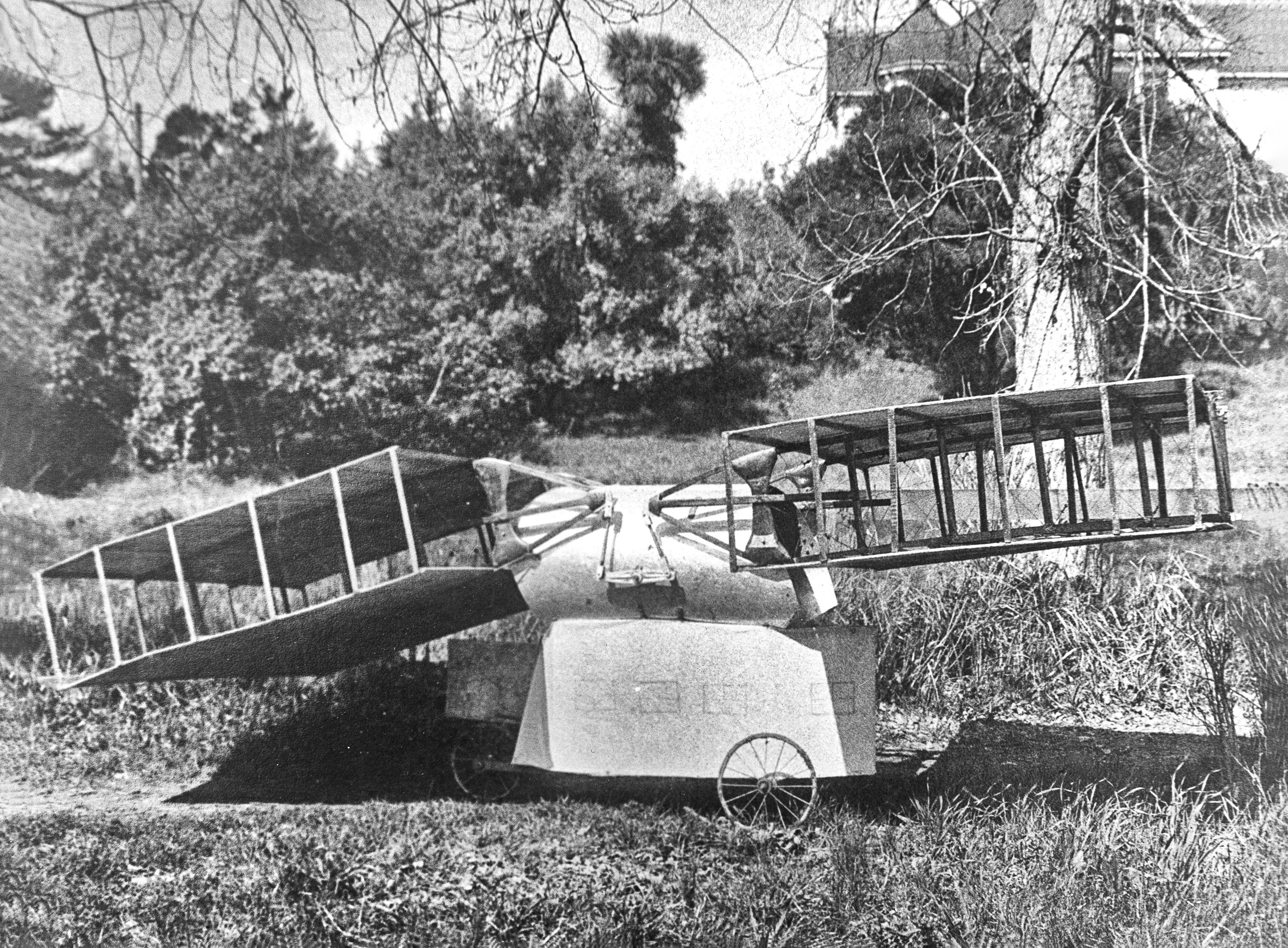
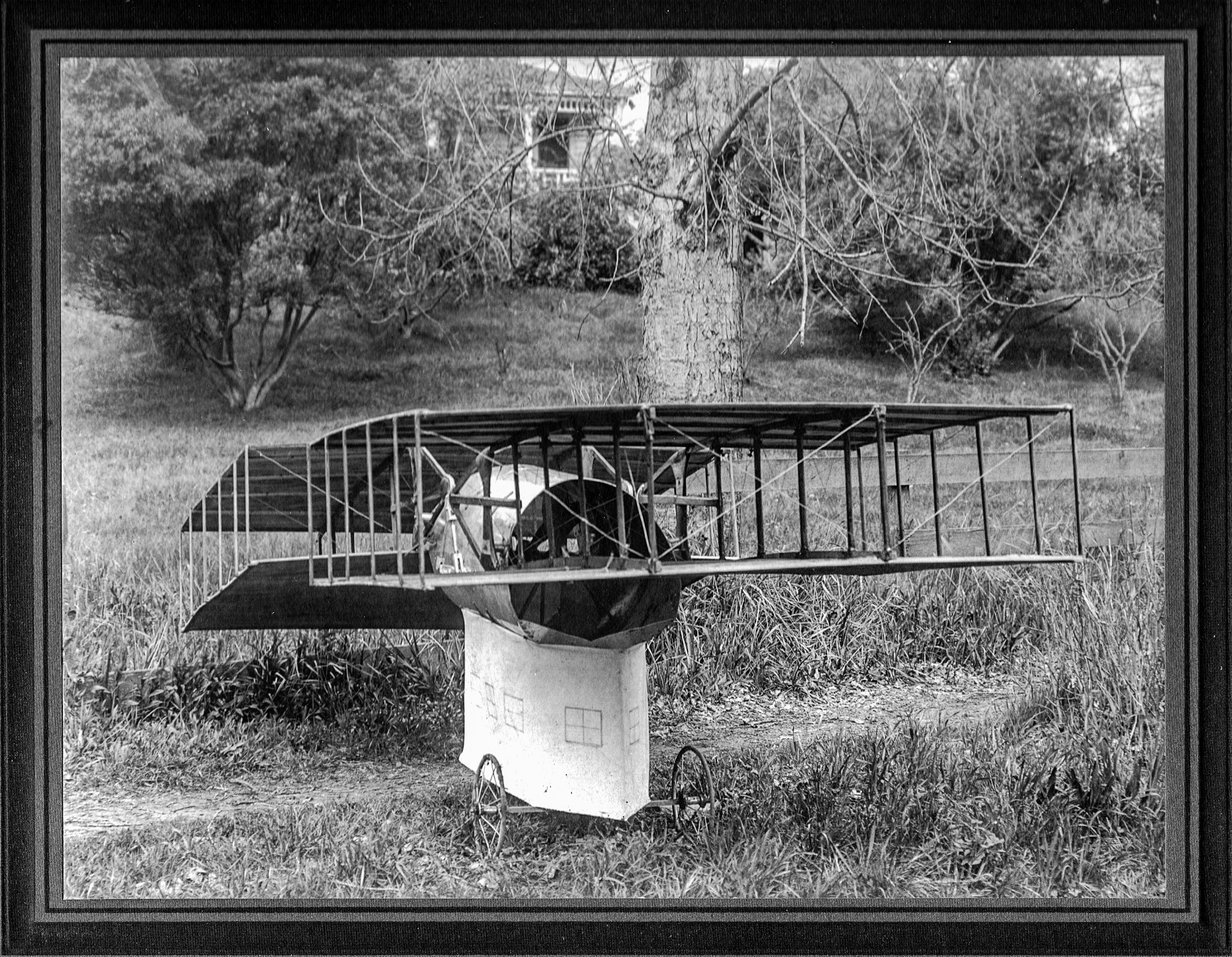
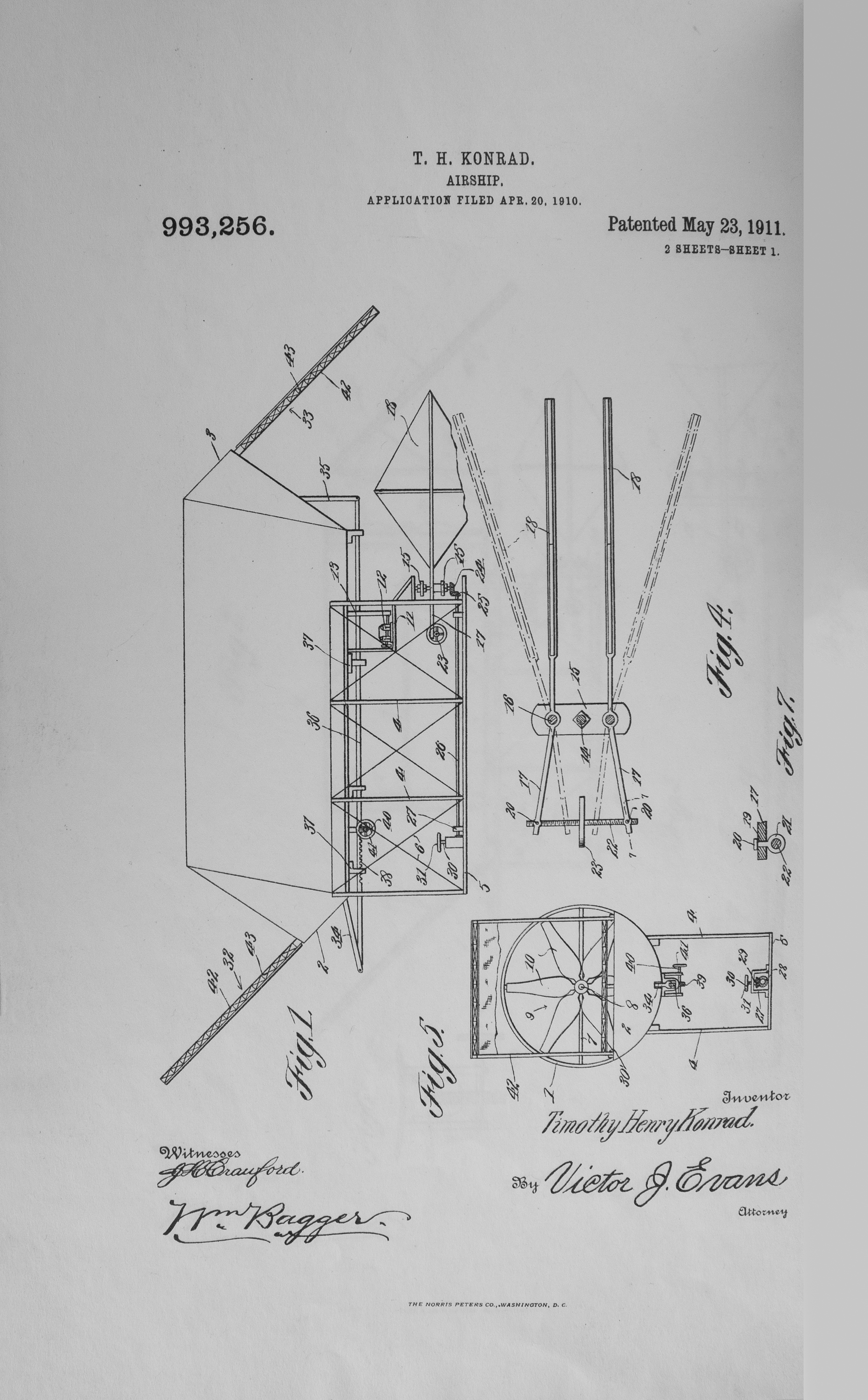
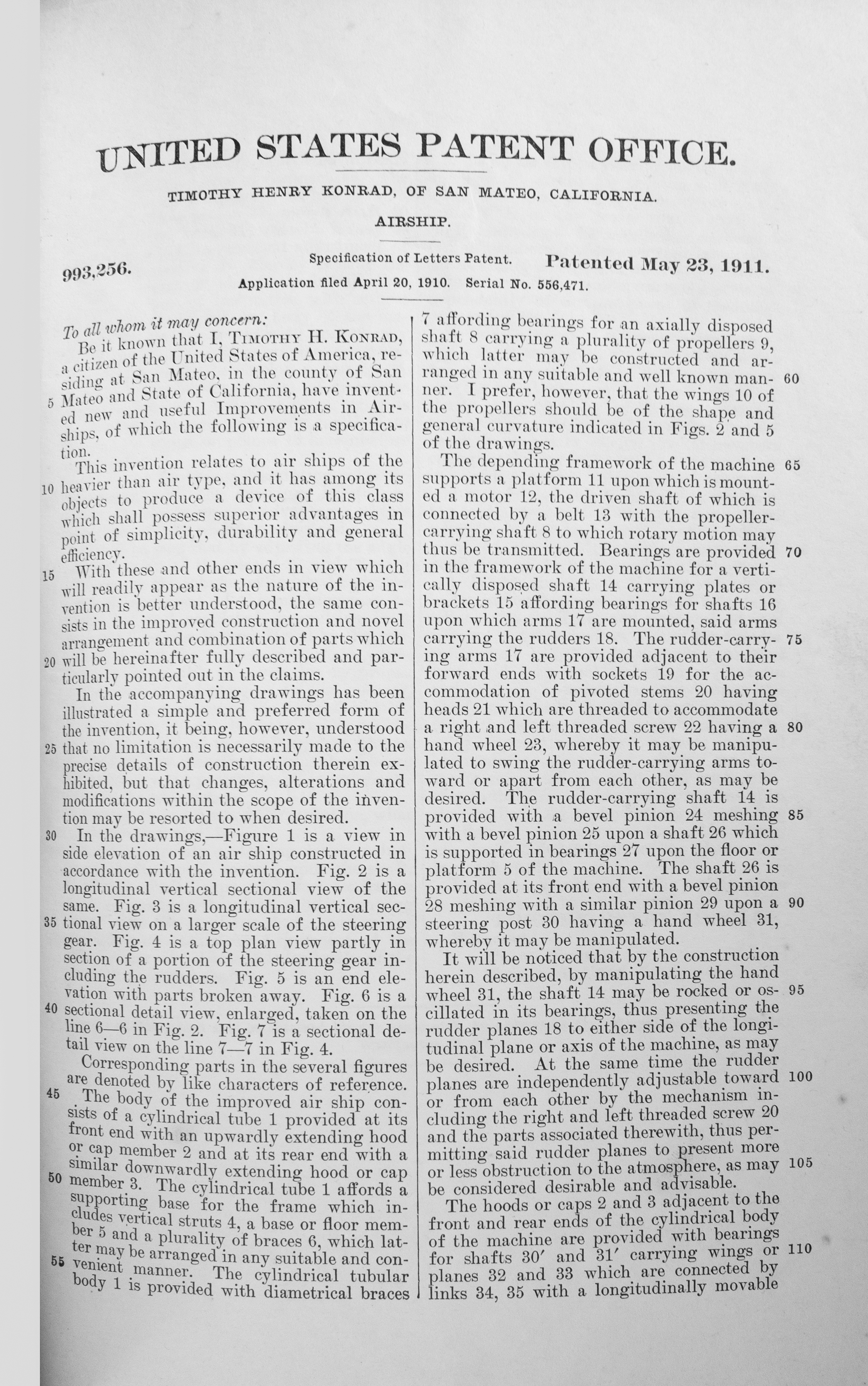
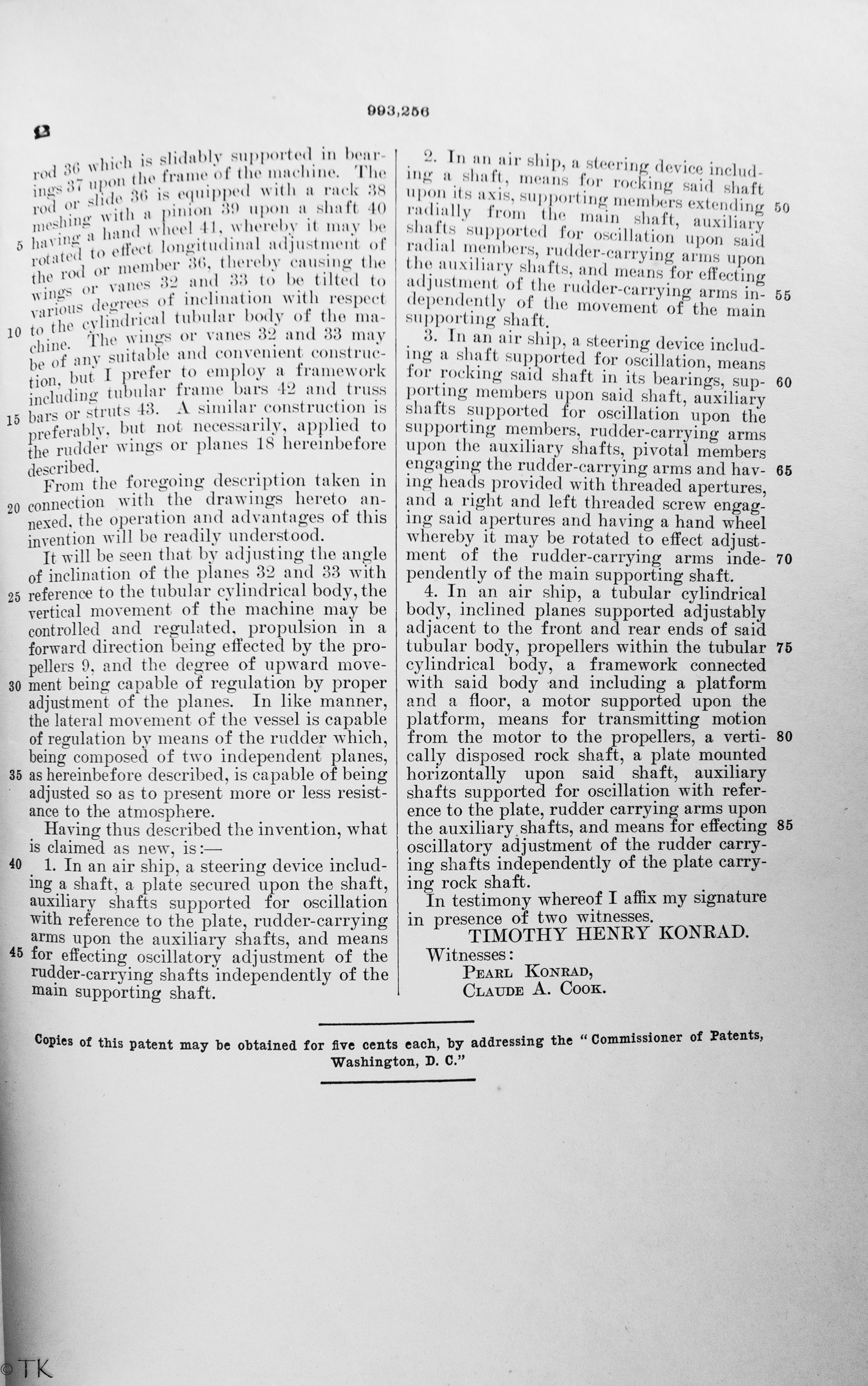
    In 1913, my grandfather invented a motorized airplane. He obtained patents for his invention in the US and 6 other countries.

    My grandfather, Tim, fabricated the aircraft in his machinist shop in San Mateo, back when the idea of airplanes was just beginning to get off the ground, so to speak.

    Twenty-nine feet in length, the craft consisted of a long cylindrical fuselage, open on each end, with propellers affixed front and aft. It featured wings that were biplane by design, but rather than extending laterally, like other aircraft, they extended out the front and back. The wings could be raised and lowered to control lift.

    The prototype Tim constructed was not designed to carry passengers: It was piloted remotely via cables my grandpa operated while riding ahead of the contraption on a motorcycle: At one time, he used to fly it down the main street of San Mateo on Sunday mornings.

    As my father explained it to me, the open fuselage with the twin propellors at both the front and rear of the cylinder created an airflow through the body of the craft, presaging the later development of the jet engine.

    The Patent

    I’ve thought it would be interesting to run that jet-flow idea by an aerospace engineer, but to date I’ve yet to meet one.

    Schematics, from the patent

    I was never told the story of whatever came of my grandfather’s airplane. Subsequent aircraft favored the more traditional design featuring wings perpendicular to the fuselage—obviously the winner in the design competition.

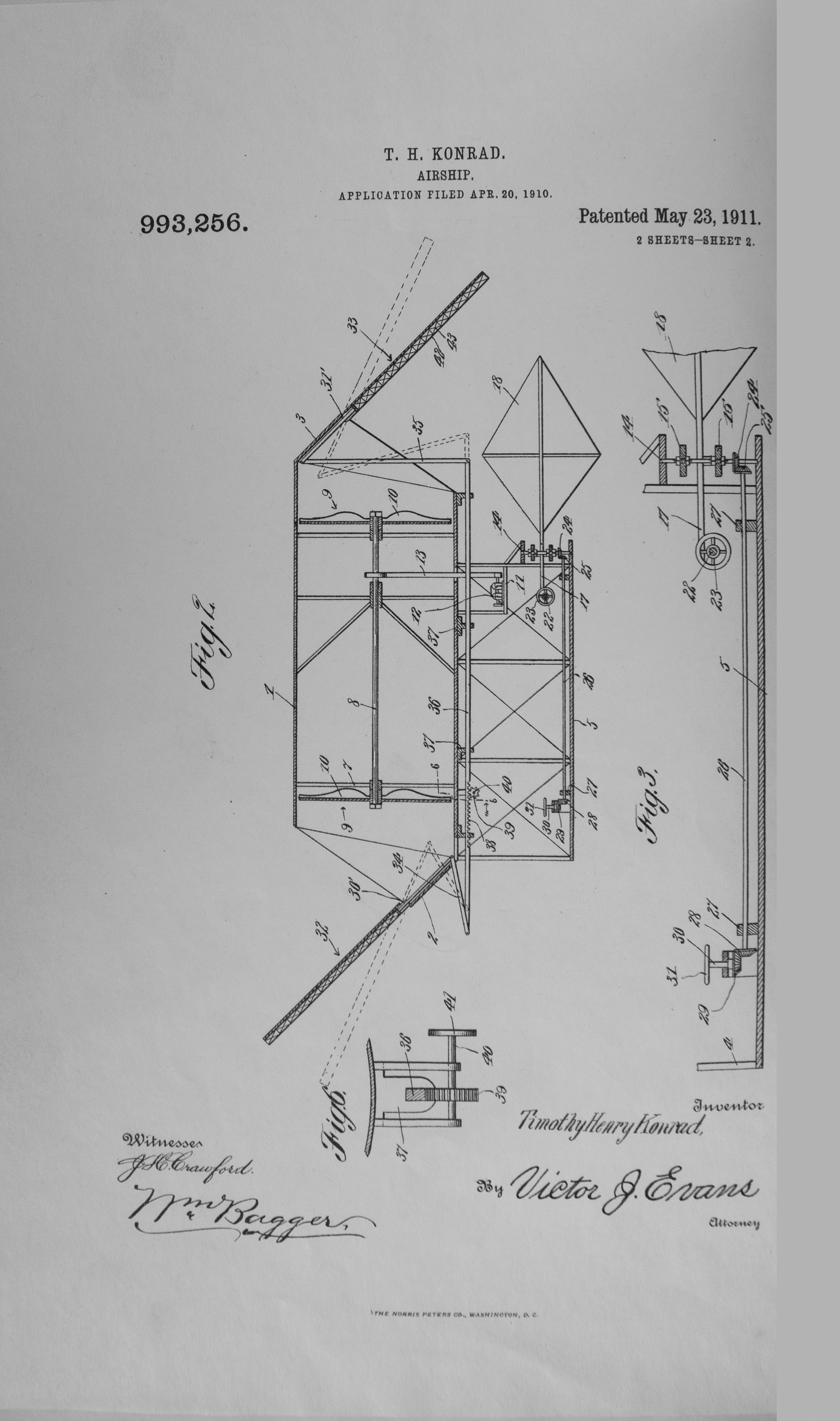
    Schematics, from the patent

    I’ve always wondered how the lack of lateral wings affected the flight stability of my grandfather’s airplane. The ubiquitous lateral-wing design seemed more intuitive.

    A portion of the description of the aircraft, from the patent
    The last page of the patent. (Note that copies “may be obtained for five cents each.” My, how the times have changed!)

    Again, though, that’s nothing but pure speculation on my part, as I have absolutely no knowledge that would qualify me to speak on the topic beyond a layman’s level.

    I wish I’d been old enough to ask my grandfather these questions, and many more, while he was still around, but he flew off to the Great Beyond when I was just a few months shy of ten years old.

    ***

    One of the occasional twists of irony that make life such an interesting and rewarding affair occurred decades after Tim invented his airplane. Concerned over the growing threat to our nation following the Japanese invasion of Pearl Harbor, my grandfather contributed to the war effort by donating another of his inventions—an anti-aircraft gunsight—to the United States Navy.  

    To be continued:

  • My godfather introduced me to Spam when I was around nine years of age. The idea of meat being processed and encased in a tin can turned me off back then and continues to perplex me, when I think of it (which is hardly ever) to this day.

    During the second World War, the Brits called the stuff, likely with a grimace and a nod to the absurd, “Special Processed American Meat,” hence, Spam. Monty Python is credited with first applying the term to junk email in a sketch that represented the product as “ubiquitous, unavoidable and repetitive.”

    It’s oddly fitting then that, in the age of the internet, the name ‘spam’ has come to describe the torrent of unsolicited emails shamelessly assaulting our inboxes each day. Whether by pure chance or cosmic intervention, the irony of that designation is a stunning as it is distressing.

    Today I have received 30 spam emails and it’s only a little past noon. They’re the usual ones, purporting to offer me relief from a panoply of problems—a list of troubles covering everything from obesity and hearing issues to skin tag removal and foot massage carpeting., with brief interludes to reflect on deadly fungus, blood balance and failing eyesight.  Curiously, there are also repeated attempts to interest me in tactical air drones. I wonder if these can be programmed to seek and destroy the servers spreading this shit? Not likely, but one can hope!

    I’m not a reckless internet explorer (Internaut?) nor a seeker of sensate online pleasures. I avoid sites with even the slightest hint of inappropriateness, sensationalism or sheer idiocy. I never open attachments from people I don’t know, and I always note the return addresses on incoming posts before opening them.

    In spite of these and other precautions, however, somewhere in my relatively cautious online ramblings I must have fallen prey to the offspring of some soulless inbred cretin offering a solution to a problem that didn’t exist before I clicked that harmless-looking little check-box.

    Now I’m besieged daily with an onslaught of drivel. And, as if that’s not enough, I receive much of it in duplicate. Back-to-back offers from Bye bye fat, Footy Massage Carpet, I-hand Massager, Skin Tag Remover, iHear Pro, Health Tips-Blood Sugar, Health Tips, SkinCell Advanced, Deadly Fungus, and Fit Living. And the day is still young. Who knows what the true count will be when the clock strikes midnight?

    It’s quite obvious, judging from the titles, that I’ve been assigned to a demographic whose twin primary foci are remote-controlled flying machines and the joyful physical changes that accompany advancing seniority.  If I were to make comparisons based on these criteria, notwithstanding an apparent fascination with aeronautics, it would be encouraging to discover that, so far at least, I’m not in need of fat cures or fungus therapy, Skin tag removal, maybe, but if I were of a mind to write down my physical complaints in order of priority, that one would be nowhere near the top of the list.

    On the other hand, the pessimist in me might view this parade of purported proposals for prospective problems purely in negative terms. Just look, I might tell myself, at all the dreadful things that are liable to befall me sooner or later!

    But not today! Such talk is the main reason
    I keep my pessimistic side on a short leash.

    ***

    When faced with the deluge of dubious dreck  that accumulate daily in my inbox like turds in a toilet, my first instinct is to flush the damn thing, email address and all, re-brand myself and begin anew.

    Alas! If such a thing were easy, I would have done it long ago. It’s not as if I’m so enamored of my username that I can’t bear to change it. And there’s no love lost when it comes to my relationship with Comcast!

    That said, the problem is I’ve had the same email address for so long now it’s become associated with more sites than I can possibly remember. Each of these would require updating if I were to change my username.

    Then again, maybe I’m looking at it all wrong! Perhaps what I have is a solution disguised as a problem. I suppose if I were to make the change and update every site I can remember, whatever fell through the cracks, if it was important, would make its displeasure known to me sooner or later.

    That’s strangely akin to losing data to a hard drive crash, only without the feedback, or losing your belongings to a house fire. Each is brutal in its own way and, while I recommend neither, I can say from experience that both are effective. And, good news! There is life after data loss!

    While virtual reincarnation is certainly something to consider, for now at least, I’m putting up with the spam, hoping each day as I move the shite to the “spam” folder that this might be the day my AI driven, so-called “intelligent” spam software will awaken and start filtering the dross out for me.

    In the meantime, I try to find the humor in noting the inanity of pitches like that of the “Quinux Drone 4k” that offers to provide “intelligent battery with long battery life.” On its face, it sounds pretty good until I note it’s only referring to the flying robot’s battery state and is making no assertions regarding my personal energy level.

    Alright, that was a bit corny, I’ll admit, but look what I had to work with? Thankfully solace can be found in the strangest (or dumbest) of places. If the Quinix Drone 4k lacks the intelligence to extend my battery life, perhaps my daily sorties to the spam folder will keep me on my toes, so to speak, by helping me maintain my mental agility as I watch my physical body slowly surrender to the steady pull of time’s gravity.

    One can always hope . . .

    Tim Konrad
    January 23, 2022

  • A collection of short essays on my recollections of growing up in the Sierra foothills in the 1950s.

    The year was 1913. My paternal grandfather, Timothy “Pop” Konrad, was living in San Mateo, California, married, with a wife and three children to support. The growing popularity of automobiles had led him to expand his blacksmithing business to include the care and maintenance of these vehicles. In addition, he had only recently obtained patents for an airplane he had invented in his blacksmithing shop.

    Things appeared to be going well when, without warning, my grandmother, Pearl, fell ill. She lay in hospital for a week without a diagnosis, her condition worsening each day until, finally, she succumbed. It was later determined she had died of a ruptured appendix. The hospital’s malfeasance was the primary reason my father held a dim view of doctors until his dying day.

    After Pearl’s passing, my grandfather took in a roommate—my mother’s aunt Veda—to help out with the children. My aunt Dorothy was nine at the time, my dad was seven and my uncle Jack was three.

    ***

    In 1917 the country and the world were ravaged by the Spanish Flu pandemic. Among its many casualties was my maternal grandfather, Bert Cartwright. My mother was seven when her father died; both she and her brother, Jack, also contracted the illness but survived.

    My grandmother, Lowney, newly widowed, sent my mother and uncle to live with her sister Veda in California and my extended birth family was born.

    ***

    My grandfather and Veda remained roommates, minus a few interruptions, until Veda’s death, around 1951, despite her cycling through several husbands along the way. One of those husbands was Charlie Silva. I knew Charlie and his wife Marie when I was a small child. They used to live out in Shaw’s Flat in a pleasant little house with a huge weeping willow tree in its front yard. Before my time, Charlie had been married to Veda, but their friendship had endured and they’d all remained friends, my grandpa and Marie included, until the end of their lives. I remember Charlie as a kind and gentle soul with a most arresting smile. Witnessing their camaraderie as a child served as a proof, although I wouldn’t realize it until much later, that it was possible to maintain friendships beyond marriage.

    My father, on the other hand, never warmed to Veda; he viewed her as a user, someone who would always put her needs first, regardless of the circumstances.

    ***

    My grandfather’s mother died in childbirth. His father subsequently succumbed to a brain aneurysm,  at age 29, while smoking a cigar. Orphaned at three months, young Tim was raised by family friends in Covington, Kentucky.

    In his youth, Tim longed to be a railroad engineer, but he suffered from a partial hearing loss that placed that dream beyond his reach. He became a machinist instead, but, feeling unfulfilled, and yearning for more, he took to adventuring in Mexico, where he searched for buried Spanish gold in the state of Colima on Mexico’s Pacific coast.

    Discovering what he believed to be a large cache of treasure concealed in a cavern perched perilously in a seaside cliff, Tim miscalculated the amount of explosive needed to widen its opening for further exploration. The resulting explosion blasted the grotto, as well as whatever contents may have existed, into the ocean below.

    This was during the period when Pancho Villa was stirring up trouble in the region. Tim’s return to the States was hastened upon learning he was being sought by people aggrieved over a matter concerning the honor of a certain Mexican senorita.

    Eventually landing in San Mateo, Pop became by turns a blacksmith, an auto mechanic and an inventor. 

    Possessed of a restless spirit, Tim briefly considered an overseas job when the Russian government announced a drive to recruit machinists to help expand their railway system. Fortunately, he chose to forgo the opportunity, a decision that proved to be prescient when many of those who responded were later killed in the Bolshevik Revolution of 1917.

    ***

     Although the dust had settled from the bustle of the Gold Rush decades earlier, it was the promise of gold that brought my grandfather to the hills outside of Columbia a few years later, where he and a small group of investors had purchased a working gold mine on the banks of the south side of the subsequently submerged Stanislaus River not far upstream from Parrott’s Ferry.

    Parrott’s Ferry on the Stanislaus River, as viewed from the Calaveras County side of the river

    Known as the Republic Mine, the venture never turned out to be the source of riches my grandpa had hoped for but did manage to provide a stable enough base for him and his family to successfully navigate the depths of the Great Depression.

    The mine turned out to be unprofitable for the stock-holders; what earnings it produced were consumed meeting the expenses necessary for maintenance and upkeep. The occasional poached deer kept food on the table.

    My father told stories about how he and his friends used to hike upstream to gather firewood, where they would fashion rafts out of driftwood to transport the wood, and themselves, downriver to where their cabin was located. Those days were happy ones, as evidenced by the wide smile my father would always display when recounting his adventures.

    My grandmother, Lowney, eventually followed her children to California. At some point, she met and married her second husband, Ernest Wolfe, with whom she bore her third child, who became my Uncle Bob. By then, my mother was a teenager, and she and Ernest didn’t mix well. After an incident in which Ernest physically abused her, my grandmother shipped my mother off to Tuolumne County to live at the mine with Veda and my father’s family.

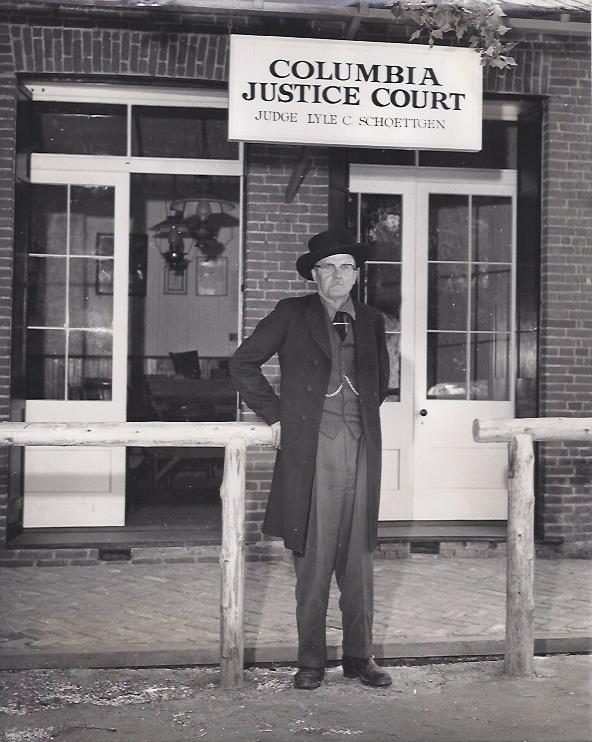
    On account of these unusual and tragic developments, my mother and father essentially grew up together, largely in the same household. The early mining venture at the Republic Mine was abandoned in favor of another opportunity and the family moved upstream to take over the operation of the Von Tromp Mine. The Von Tromp was located on the south side of the river canyon not far from the larger Experimental Mine. That mine was located, a few miles past Columbia at the end of Experimental Mine Road, off of Italian Bar Road. My father and his brother, also named Jack, worked this mine with my grandfather and assorted others, among whom was Lyle Schoettgen, who in later years became Columbia’s justice court judge. 

    Judge Lyle Schoettgen

    My father and Lyle shared a cabin together back when they were drilling and blasting their way into the mountainside following gold-bearing quartz veins, minus the use of air filtration devices, as was the custom in those days. Consequently, both men exhibited signs of respiratory distress in later life, accompanied by a frightening-sounding cough. While my father’s cough was distressing-sounding, Lyle’s cough sounded tubercular. My father once told me that Lyle suffered from silicosis, which may well have contributed to his eventual demise.

    It was during this time that my family became acquainted with the Ponce family, descendants of Chilean miners who came to Tuolumne County during the Gold Rush The Ponces lived at a ranch just up the road from the Von Tromp Mine. One of Lee Ponce’s brothers was killed while working at the Von Tromp mine. He’d been investigating a fuse that had failed to fire when it had gone off unexpectedly, blowing him up in the process. Such accidents were not uncommon back then, as there was no way to determine why a charge had failed to ignite except through visual inspection.

    My family’s friendship with the Ponce family endured into the 1950s and beyond when Lee and Al Ponce and their wives Pearl and Francis operated the Stage Drivers’ Retreat—the saloon in Columbia currently known as the Jack Douglass. My parents used to frequent the Stage Drivers’ Retreat for beers on Sunday afternoons, where they would catch up on the latest Columbia news.

    Al Ponce

    My dad had long been skeptical of the profitability of gold mining when, sometime in the latter part of the 1920s, he became totally disillusioned with it and got a job working as a house painter in Sonora. He had apprenticed in his teen years under a Hungarian house painter in San Mateo, where he’d learned everything from how to make paint out of lead paste and linseed oil to applying antique finishes and hanging exotic wallpapers. 

    The new job in Sonora afforded my dad the opportunity to put his painting skills to use. While he was living at the mine, my father had been giving his earnings to Veda, who handled the money for the family. He resented how she would, in his mind, “spend all the money on chocolates” instead of using it for things he considered more essential. When, after he’d been on the job for a few months, he’d gotten a raise, he hadn’t shared the news at home, instead saving the extra funds until he’d accumulated enough money to elope with my mother and establish a residence in Sonora.

    To be continued:


  • A collection of short essays on my recollections of growing up in the Sierra foothills in the 1950s.

    The onset of shorter days and cooler nights that is part and parcel of early November brings to mind the smell of burning leaves—an activity my father routinely performed that time of year back before air pollution caused the practice to be evaluated and subsequently prohibited. We had a number of large-leafed trees on our lot—mostly walnuts and sycamores—that each year produced huge volumes of leaves in need of disposal. Back then, city residents had the option to dump their piles of leaves and other yard debris on the side of the street, where city work crews would periodically come by and haul them off free of charge.  As noted previously, it was a simpler time.

    For reasons I never fully explored, my father sometimes chose to round up the expired vegetable matter and instead burn it in his burning barrel. The device consisted of a recycled 50-gallon stove oil drum with the top removed and a small vent hole piercing the side near the bottom to provide better air circulation and thereby, more efficient combustion. The top was covered by a suitably sized piece of heavy metal mesh screening, designed to prevent sparks from escaping.

    Just as the startling displays of color provided each year by its fall foliage signaled the approach of winter, the smell of leaves burning in my dad’s burning barrel became forever associated in my mind with autumn’s glory.

    When the memories of summer grew more distant and weather patterns favored rain, part of the annual ritual of the seasons dictated that exposed water pipes be inspected to make sure their newspaper wrappings were in good enough order to withstand the winter temperatures. Back in the 1950s, the weather was colder in Sonora and hard freezes were more the norm than the exception they are today. Snowfall was more frequent and significant then as well, and it was not uncommon for the careless or ill-prepared to wake up to discover their water pipes frozen or worse—burst open.

    ***

    In December of 1955, it rained for two whole weeks without stopping. It rained so much it washed away the Highway 49 bridge spanning the Stanislaus River at Melones about a half-hour after my father drove across it. The storm also caused significant flooding around Sacramento. The Yolo Causeway was constructed after the deluge in response to this flood.

    I still remember this event vividly because the dates of the rainstorm corresponded with the two-week school-break we kids got off for Christmas vacation. My mother would never let me play outside when it was storming. Since it rained the entirety of those two weeks, she kept me inside for the duration, insuring the school break would remain etched in my mind as a ponderously long, boring and frustrating way to celebrate a vacation. That series of storms famously became known, with more than a touch of irony (at least for me personally) as the “Christmas Floods.”

    An additional local casualty of the flooding was the loss of an historic covered bridge that used to span the South Fork of the Stanislaus River at Pine Log Crossing, upriver from its confluence with the river’s main fork. The site was only accessible via a steep and strenuous hiking trail that descended the canyon from the lower end of Experimental Gulch Road, a couple miles northeast of Columbia. Narrower in width than covered bridges the likes of the one still standing at Knight’s Ferry, the bridge at Pine Log Crossing was designed to facilitate pre-20th Century foot and equestrian traffic only.

    I crossed this bridge on a hike with my father in the summer of 1954, en route to a place called Crystal Cave, or Crystal Palace, a limestone cavern nestled in a gulch partway up the other side of the canyon. Not far from the bridge once sat a ramshackle cabin.  My father told me the cabin was inhabited by an old hermit who avoided people when they came near.

    I remember having seen someone dart off into the bushes when we’d gone by the place on our way to the cave. A year or two later I saw a news item in the local newspaper saying the remains of someone—likely the old hermit—had been discovered by some deer hunters, not far from the cabin.

    The site of a thriving mining camp back during the Gold Rush, few people these days have likely ever even heard of Pine Log Crossing.

    Crystal Cave was a limestone cavern with several levels that extended deep underground. The entrance to the cave was set into the side of a gully part way up the mountain crowned by the American Camp Fire Lookout tower.

    A foundation outline was all that remained of what had once been a house situated in a pleasant meadow a couple hundred yards uphill from the cave’s entrance. Some years later, I had the opportunity to meet in Columbia with an old woman who had lived in that house as a young bride back in the 19th century. She told me her husband had discovered the cave while rabbit hunting, when he’d been led to its entrance by a rabbit he had shot and wounded.

    The old woman also recounted how her husband would periodically make the long trek to Columbia for provisions, leaving her home by herself.  On one such occasion, an Indian man appeared while she was tending her garden. Frightened, defenseless and unsure of the fellow’s intentions, the woman created the impression that her husband was off working nearby, to dissuade him, in her words, “from trying any funny business.”

    +++

    My love affair with the Stanislaus River began in my childhood when my parents brought me to Parrott’s Ferry on outings, dating as far back as I can remember.

    Dad, Aunt Weltha (Cousin Linda’s mother) & Mom at Parrott’s Ferry

    Parrott’s Ferry held special significance for my mother and father as they used to live, for several years during the Great Depression, on a mining claim just upstream of the Highway 49 crossing. Times were hard then, and fending off the land, aided by poaching the occasional deer, and “making do” with the barest of essentials became necessary adjuncts to survival.

    I grew up hearing stories of how my dad and his friends would hike up the river to gather firewood that they would then fasten into rafts and float downstream where they could be used to keep the home fires burning.

    Despite the hardships encountered, my parents’ stories of their time living on the river were always tinged with the kind of nostalgia that only accompanies the happiest of memories. They had the gift of youth, with all its attendant hopefulness, plus the great good fortune to be living beside a singularly beautiful river, in a simpler time, among friends and family all conjoined in common enterprise, unlike the soul stultifying preoccupation with self that characterizes the ways in which people relate, or don’t, to each other today.

    Going swimming at the river was an activity I found myself engaged in at every opportunity once I grew old enough to drive myself to such places. With the inundation of the Tuolumne River that followed the raising of the New Don Pedro Dam in 1971, the Stanislaus River was the only remaining river locally that remained easily accessible. In the late 70s, in response to increasing demands for downstream irrigation needs, that river, too, became inundated “in the name of progress.” 

    Authorized in 1944 as a part of the Central Valley Project, Melones Dam was originally designed to provide irrigation water to farmers in the San Joaquin Valley. This dam was replaced by a higher dam, completed in 1978, creating California’s fourth-largest reservoir. In addition to expanding the river’s capacity to supply irrigation water, the new dam also allowed for hydropower generation and provided improved flood control and recreational benefits.

    The expansion of the dam was controversial in its time and became the focus, during the 1970s and early 80s, of a prolonged environmental struggle, pitting those who wished to protect the scenic integrity of the (mostly, at that time) free-flowing Stanislaus River against the proponents of bigger and better dams. While the project’s proponents touted the dam’s perceived benefits, environmentalists, sportsmen, river rafters and others cited concerns ranging from loss of wildlife habitat to concerns about water quality.  

    Soon, lines were drawn and battle cries chosen, the river’s protectors hoisting banners proclaiming “Save the River,” while the other side produced bumper stickers exclaiming “Fill the Dam.” Inflamed by local politics, misinformation and rumor-mongering, passions ran high during that time, one stalwart river defender even going so far as to chain himself to a tree below the soon-to-be water line in an ultimately futile attempt to halt the reservoir’s filling. While the protestors who gathered in support of this failed venture were unsuccessful in turning back the clock on the new reservoir’s completion, they did succeed in bringing national attention to the larger battle of protecting the nation’s remaining free-flowing rivers, galvanizing California’s river conservation movement and influencing subsequent water policy changes on both the state and federal levels.

    Living through that period in the county’s history and closely following developments as they unfolded provided me the opportunity to observe some of the more vexing aspects of human nature. The ideas beliefs and dreams of both sides of the conflict were on almost daily display in the local news, with both trying in their various ways to persuade others to support their respective positions.

    Curiously, and tellingly, however, the two sides’ arguments were neither symmetrical nor equivalent. While the river’s defenders mostly relied on accurate and verifiable information in defense of their cause, the dam’s proponents operated free of such restraints, employing misinformation and hyperbole to spread fear, confusion and distrust among the people, much the same as present-day so-called Republicans employ similar tactics in the furtherance of their disingenuous, twisted and cynical agendas.

    To be continued:

  • A collection of short essays on my recollections of growing up in the Sierra foothills in the 1950s.

    Recollections of my maternal grandmother

    Part II

    My grandmother lived in San Mateo and my parents and I would make the long journey down from the hills and across the Central Valley to see her every 6 weeks or so. The trip took longer back then. There were no divided highways at all until we reached Alameda County, and the road went straight through downtown Manteca and Tracy, which slowed things even more. Crossing the San Mateo Bay Bridge, you could always tell when you were nearing San Mateo by the scent of the noxious perfume produced by the mixture of salt water with the city’s sewage as it was released into the bay.

    When I was a young child, my parents would sometimes leave me with my grandmother for a week during summer vacation. My grandma wouldn’t let me play outside with the other kids in the neighborhood, but she never offered any explanation other than to say that it would only lead to trouble.

    This didn’t sit well with who I fancied myself to be as a child, or, for that matter, at just about any other point in my life. In response, I went out and played with a neighbor boy a couple of times in defiance of her orders. Each time I did so, she would scold me fiercely afterward.

    ***

    Once I remember going to a drive-in movie with my grandma and one of her women friends who lived across the street and down a few doors from her house.

    The woman, Mrs. Hultberg—my grandma and her friends always addressed each other formally—sat in the passenger seat of my grandma’s classic old 1939 Ford coupe. My grandma sat behind the wheel, with me perched in the back seat  watching the movie over their shoulders.

    The flick was a jungle thriller, shot in black and white, featuring European explorers in Pith helmets traversing the jungles in search of a gold cache allegedly buried in a “lost city” somewhere in Brazil’s Amazonia.

     Actors portraying jungle explorers always wore those strange-looking head-toppings in the movies back then. No respectable jungle romp was without them.

    Looking back on it, the whole thing seemed quite surreal—me sitting in a really cool old car perched between two old women watching people being ravaged by fierce savages or stripped clean of their flesh by roiling schools of bloodthirsty piranhas.

    ***

    I tried several times in my teen years to buy that car from my grandma. She hardly ever used it at that point, and had rejected several offers from eager young auto enthusiasts interested in purchasing it, yet she showed no interest in entertaining my offers.

    ***

    Another recollection I have concerning my grandma was the time we sat together in my parents’ Oldsmobile in a parking lot at the Hillsdale Mall in San Mateo while they shopped for Christmas presents.

    I was older by then, perhaps 12, and remember being fascinated by my grandmother’s recounting of her experiences in Utah during the great influenza epidemic of 1918, the pandemic that took her husband, my grandfather Bert’s life.

    My grandma explained how, early in the ordeal, my grandfather and mother and her brother Jack had come down with the virus and how their entire household had been subsequently quarantined for the duration of the epidemic.

    In the beginning, friends would come by to see them, wearing masks while standing outside and visiting through an open window, sometimes bringing food to share.

    As the epidemic wore on, my grandmother said, fewer and fewer of their friends appeared at the window, until finally, hardly anyone showed up.

    Afterward, they learned that many of their friends had perished, along with one quarter of their town’s population.

    ***

    My cousin Linda, a couple of years my senior, had much more complete recollections of my grandma than I did. Accordingly, I have included an essay about her that Linda penned as a writing assignment when she was attending San Francisco State College in the early 60s. I particularly like the imagery Linda created with her detailed recounting of our grandma’s appearance and personality!

    “My grandmother lived in an old brown shingled house in a quiet part of town, with pepper trees shading the sidewalk in front.

    She was a large woman who, as far back as I can remember, used a brown wooden cane to aid her walking.

    She always seemed ashamed of the cane and the limp in her leg which was the result of a broken hip when she was quite young.

    She was Danish and used orange food coloring to dye her white hair. It was flame-red, but she insisted that she had natural colored auburn hair.

    She always wore at least two dresses, one on top of the other, a flowered hem trailing underneath.

    She wore two pairs of thick stockings on her legs, rolled at the knees like sausages.

    I loved to watch her prepare to ‘go out gallivanting.’

    One dress of black silk sprigged with white flowers beneath a yellow checkered crepe with gold buttons down the front.

    Then the two pairs of stockings and then her jewelry.

    There was always a huge brooch at her bosom and strands of beads around her neck, one on top of the other, green shiny beads, gold chains, strings of ceramic flowers.

    She would let me pick out her rings for the day. One for each finger. And her earrings.

    I can never recall a time that she walked out her front door without her large green straw hat on, the elastic band (tucked) under her chin.

    She would periodically replace the drooping silk flowers around the band, but it was always the same hat.

    She would rouge her cheeks slightly and then her attic room would fill with powder as she patted her face in a flurry of pink dust.

    She smelled like violets.

    And with a patent leather bag on her arm and the wooden cane over the other, we would leave the house to begin our excursions.

    She drove a green 1939 Chevy coupe with a running board and a stick shift with a round shiny knob on top that had a rose inside it.

    The dash board had a rubber spider glued to it and it shivered when the car started.

    After a lot of noise and smoke we would back slowly out of the driveway and go bravely at her full speed of fifteen miles an hour down the avenue.

    She would entertain me by stopping at every pet shop we saw.

    We would wander around, playing with the animals, asking their names and what they ate as if we intended to buy one and then leave.

     Often, we went to the animal shelter on the pretext of looking for a dog or a cat and go on a tour of the shelter. This is how we would fill our afternoons together.

    Then she would take me home for dinner.

    We would eat onion and garlic sandwiches or fried scones with jelly.

    She never went anywhere without a bag of white flat mints and her kitchen cupboard had tins full of them.

    I was allowed to eat anything I wanted whenever I wished.

    She had an old and very out of tune piano in the dining room. Sometimes I would play for her and she would smile and tap her cane and fall asleep.

    In the evenings she would turn on the lamp and the gas heater and we would sit at the table playing Chinese marbles. She could play the game for hours without tiring.

    She preferred to keep me indoors with her. The neighborhood children were ‘mean little hoodlums.’

    I rarely went out front but could go in her backyard and play with her cats.

    I would sit on a marble bench surrounded by weeds taller than my head and watch a spider spinning between the fig tree and cactus while the clothesline squeaked as my grandmother hung the laundry.

    She had two lady friends, both of whom she had known for years. Until the day my grandmother died, they addressed each other as Mrs. Hultberg, Mrs. Clayton and Mrs. Wolfe.

    They were always very formal and never used first names.

    They would come and visit whenever I was staying there.

    I was usually the topic of conversation.

    I would sit fidgeting on the sofa staring out the front screen door at the kids skating down the sidewalk while my grandmother poured coffee and referred to me as the ‘poor dear.’

    Her favorite expression was ‘oh, murder.’

    The ladies loved to discuss the horror of the world and the bloodshed that was going on and ‘oh, what would it all come to?’

    And then they would warn me of the dangers of being on the streets alone and never to speak to men.

    The living room of her house was dark and faded.

    It had a long deep sofa and hand-made lace doilies on the arm rests.

    She had yellowed lace curtains gathering shadows and dust in the windows.

    My bed rolled straight out of the wall, which always amazed me.

    It did not pull from the wall or fold down, it rolled straight out of the wall leaving a dark black tunnel at its foot.

    I always supposed the cavern to be full of spiders and mice.

    My uncle had built the bed into the wall. The wall was one large shelf with cupboards and drawers and below that were two handles that pulled out my huge double bed.

    When I was very young, my grandmother would plug in a lantern on the shelf above my bed before I went to sleep.

    It was a cylinder lantern that had a forest fire scene on it. Deer were running through the trees.

    It turned around and appeared to be alive. I would lay and watch the flames until I fell asleep.

    My grandmother would give me strict instructions not to answer the front door before she said goodnight, which always left my imagination running wild.

    Who would be on the other side of the door, late at night?

    Then she would go up to her attic room and read detective stories and pulp murder magazines until late into the night.

    The next morning, she would tell me of all the horrible nightmares she had and wonder if it was the onions we ate that gave her such ‘bloody dreams.’

    Her room was full of murder magazines. In every corner and along the walls were stacks of the blood-curdling stories.

    I was not allowed to look at them. They might scare me.

    She refused to be called ‘grandmother.’ She was afraid it would age her.

    I called her by her first name, ‘Lowney.’ 

    She had been born in Logan, Utah and worked in her father’s dry good store until she married her first husband, Bert, my grandfather.

    After five years of marriage and two children, Bert died of the flu, leaving Lowney with two children and no means of support.

    She journeyed out to California to look for work and settled herself and her children in San Mateo.

    It was there that she met her second husband, Ernest Wolf. He ran the Yellow Cab Company in San Mateo.

    They were married and had a son a few years later.

    But Lowney’s temper was like fire and her moods extreme.

    Ernest was a spender and a drinker.

    She divorced him and for the rest of her life, sat inside her house in San Mateo with her cats and her youngest son.

    He spent most of his time at work. Thus, whenever I came to visit her, it was really an occasion as she didn’t have that much company.

    We both loved to fight and had the same flare for drama.

    We would sit for hours, she a woman of sixty or so, myself just nine or ten, and gossip about the problems of the world, the horror of it, and when we tired of that subject, we would begin on our family.

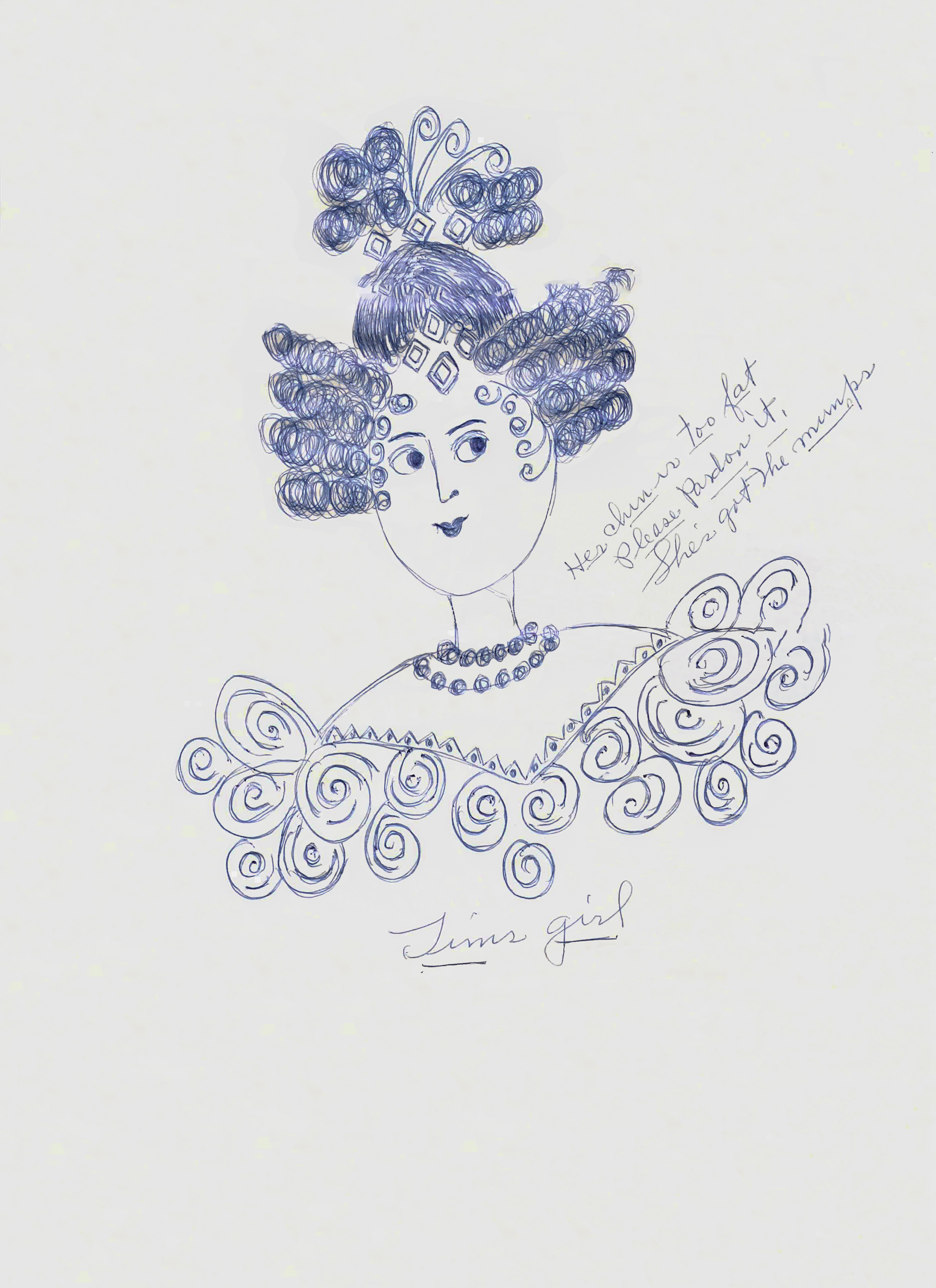
    She was an excellent cartoonist and would sometimes occupy her time by drawing with India ink clever cartoon sketches of her friends and circulate them with her correspondence.

    Every letter I received from her was full of pages of drawings.

    She might have made a living of her art, but for her lack of ambition or confidence.

    A cartoon Lowney included in a letter she wrote to me, imagining a future girlfriend

    She preferred living quietly though lonely and protected her privacy with a fierceness.

    As she aged, she began to limp more and became quite heavy but still had her love of jewelry and hats, colored calico dresses and rouge.

    She never gave in to senility. Her stubborn humor remained the same.

    She became ill in her late seventies but refused to stay in the hospital, shaking her fist at the nurses and cursing at every doctor who touched her.

    She knew she was going to die, and being rather tired of life, I think she welcomed it.

    She wanted to come home and so we brought her home to convalesce. It was in her own bed that she died, and that was of her own choice.

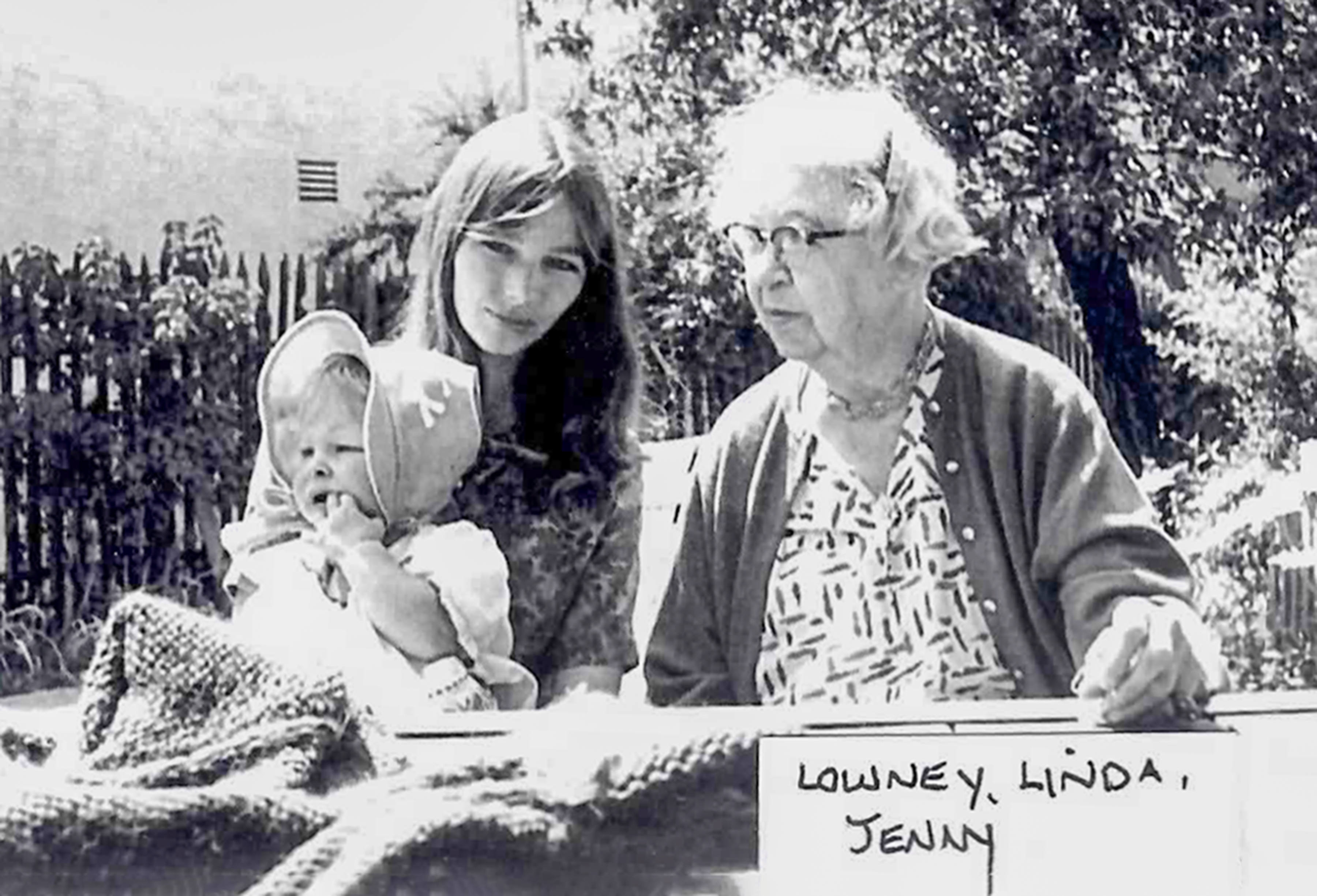
    I visited her once during this period of sickness and brought my year-old child with me.

    Linda, Lowney & Linda’s daughter, Jenny


    I placed her great-grandchild in her arms, across the blankets.

    She recognized us both, reached under her pillow, pulled out a wrinkled waxed bag of mints and, after putting one in her mouth, placed the bag in my baby’s hands.

    I had to laugh. We both did.”
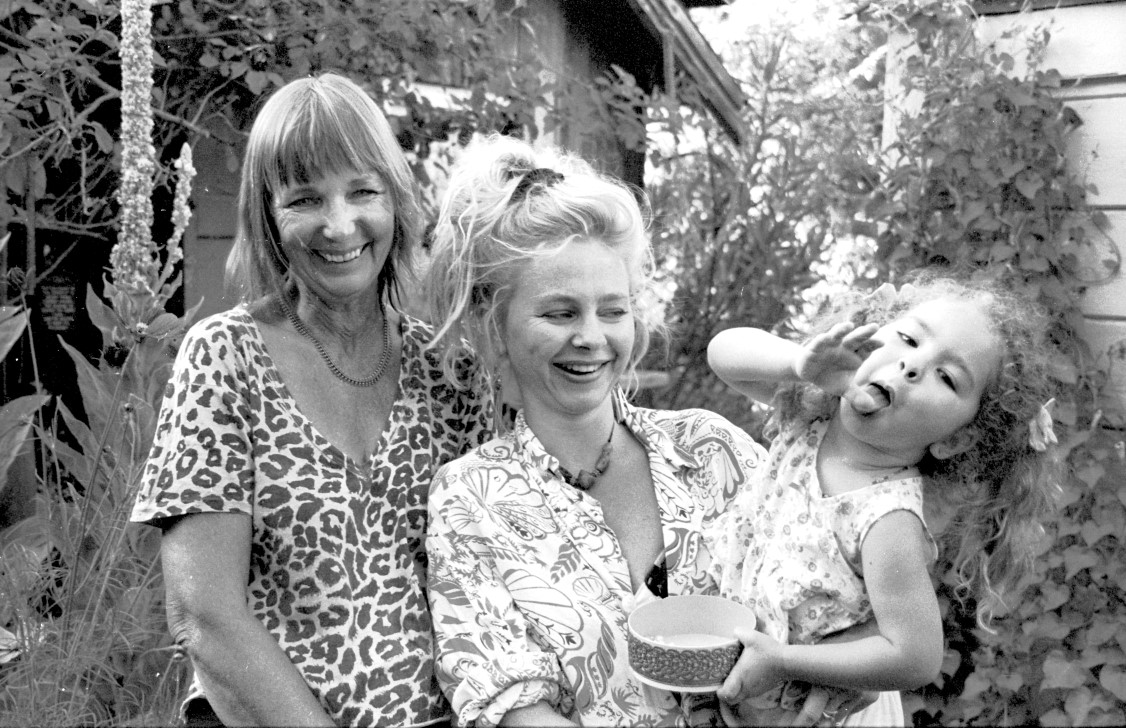
    Linda, Jenny & Jenny’s daughter, Soliana

    To be continued:

  • Sometimes,

    It feels like

    Time has been thrown

    Into a hyper-driven temporal accelerator,

    Where the hours are short as minutes

    And weeks fly by like days.

    ***

    Wednesdays, in these Covid times,

    Have become “when-days”—

    The day of the week when

    My wife’s weekly,

    Work-at-home staff meetings occur—

    Markers, each one signifying

    The passage of succeeding cycles of synopsized experience.

    Life redacted! Transformed,

    Like a real-life Readers Digest

    Run amok.

    ***

    Preparing for bed each night

    Comes around so often now

    I’ve begun to suspect the involvement of

    Some heretofore unknown malady—

    A repetitive stress syndrome of the spirit,

    A psychic de-myelination

    Buffering, like a protective barrier,

    The shock, the friction

    Of hurtling headlong

    Toward oblivion.

    Tim Konrad

    January 4, 2022